
The Global Marina Industry in 2026: A Turning Point for Waterfront Development
The global marina industry is at a turning point in 2026, driven by fleet growth outpacing berth capacity, larger vessels, rising environmental pressure, and the arrival of AI in day-to-day operations. Marinas are increasingly run as hospitality, technical, and digital ecosystems rather than places to park boats. The GCC has emerged as one of the world's most dynamic marina markets, sitting on the Europe–Asia superyacht corridor.
The marina industry is going through one of the most significant transformations in its history. Fleet expansion, environmental pressure, rising customer expectations, and new operational realities are together reshaping how marinas are designed, engineered, and run. In our analysis, 2026 is not just another year — it is the inflection point where the old marina model, built around simply supplying berths, gives way to a new one built around performance, experience, and resilience. The marinas that recognise this early will stay competitive, safe, and commercially strong; those that don't will steadily lose ground.
1. Fleet growth is outpacing marina capacity
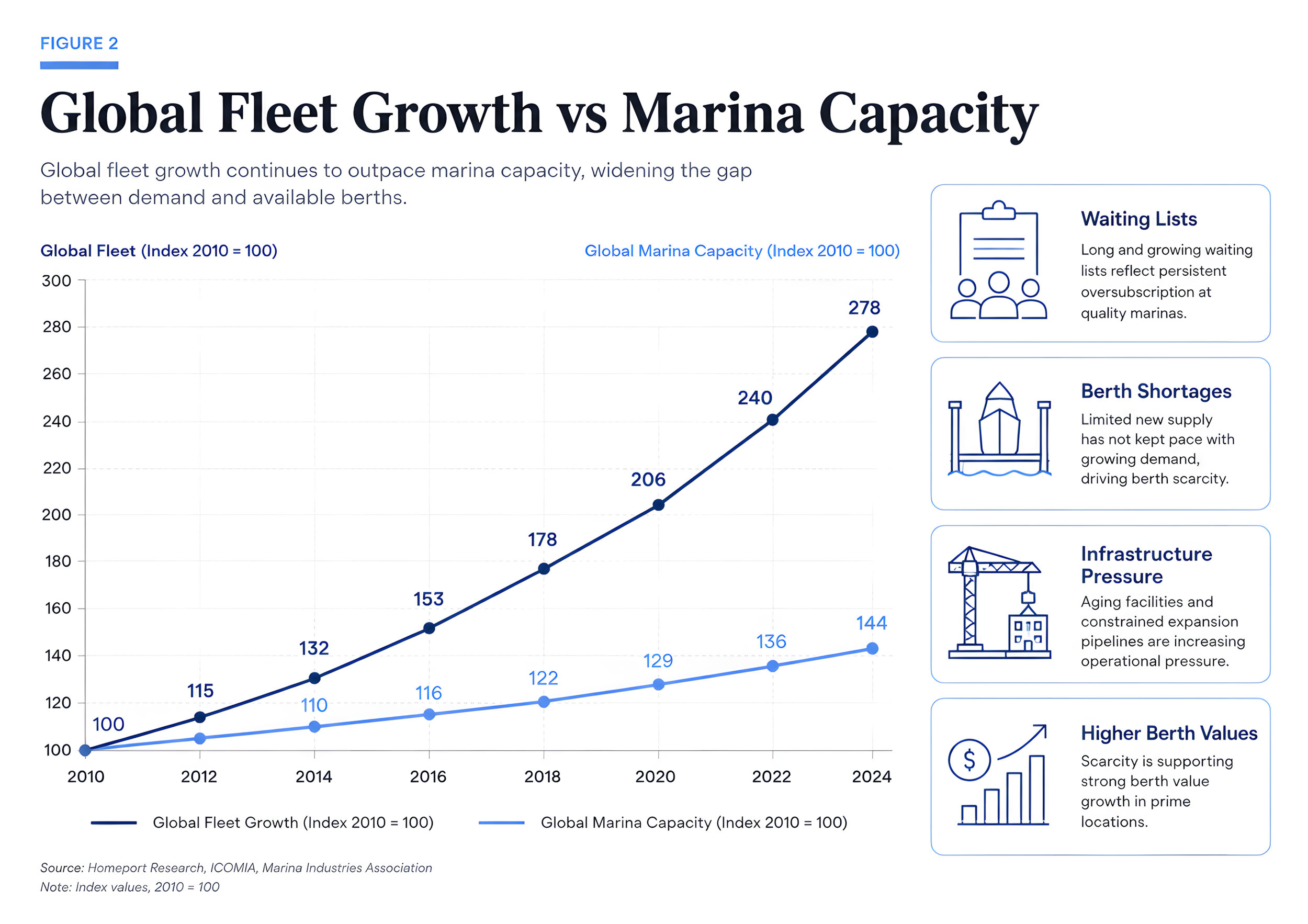
The global boating and yachting fleet keeps expanding across every size class — but berth supply has not kept pace:
· Small boats (8–15m) — the global majority by volume
· Mid-size cruisers (15–30m) — the fastest-growing lifestyle segment
· Large vessels (30–120m) — the premium, high-margin segment
Because development has lagged demand, the imbalance is now showing up as berth shortages, seasonal congestion, operational pressure, infrastructure strain, and rising customer dissatisfaction. The lesson for developers is clear: marinas must be designed for the fleet of the next twenty years, not the assumptions of the last twenty.
2. Bigger vessels are rewriting infrastructure needs
As vessels grow, the engineering behind a marina has to grow with them. Modern fleets typically require:
· deeper water — often 5–7m draft for large yachts
· far higher electrical loads — commonly 600–1,000A shore power
· larger turning basins — typically 1.5–1.75× the vessel's length overall
· high-capacity fuelling
· crew-centric facilities
· privacy and controlled access
Many marinas built before 2010 simply cannot support these demands. For those assets, 2026 is the year the infrastructure has to be upgraded — or the marina risks losing its most valuable vessels for good.
3. Marinas are now hospitality and operational ecosystems
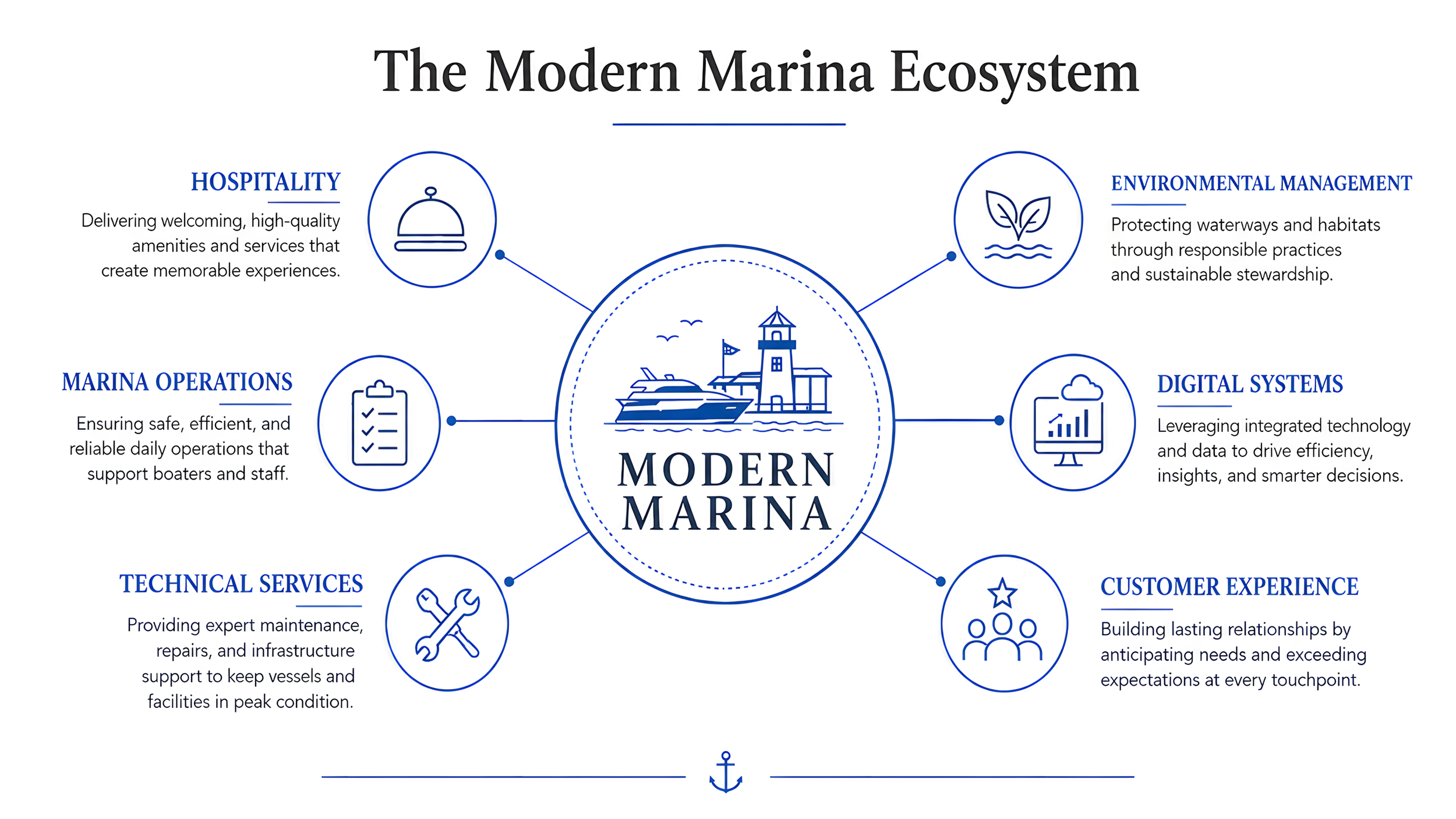
A marina is no longer a place to park a boat. Today it is, all at once, a hospitality destination, a technical operations centre, a customer-experience hub, a crew-focused service environment, a digital ecosystem, and a sustainability asset. That shift changes who decides where a vessel is based. Captains and crew increasingly choose their homeport on:
· utility reliability
· technical support
· service quality
· environmental stability
· crew facilities
Infrastructure alone no longer wins loyalty — experience does.
4. Environmental stability has become a commercial issue
Water quality has moved from an environmental footnote to a core operational — and commercial — requirement. The main risks now facing marina basins include:
· heat stress and dissolved-oxygen collapse
· algae blooms
· sediment oxygen demand
· hydrocarbon contamination
· stagnation in enclosed basins
· tightening regulation
In response, leading marinas are investing in nanobubble oxygenation, circulation modelling, environmental telemetry, automated reporting, and compliance dashboards. Clean, stable water is no longer just good stewardship — it protects revenue, reputation, and the guest experience.
5. AI is moving from optional to essential
2026 is the year artificial intelligence stops being a novelty in marina operations and becomes part of the operational backbone. Its highest-value uses include:
· dissolved-oxygen and water-quality forecasting
· vessel-movement analytics
· berth-occupancy prediction
· energy-load modelling
· safety risk detection
· environmental anomaly alerts
· compliance automation
The marinas pulling ahead are the ones treating data and AI as core infrastructure — designed in from the start, not bolted on later.
6. The GCC is becoming a global marina powerhouse
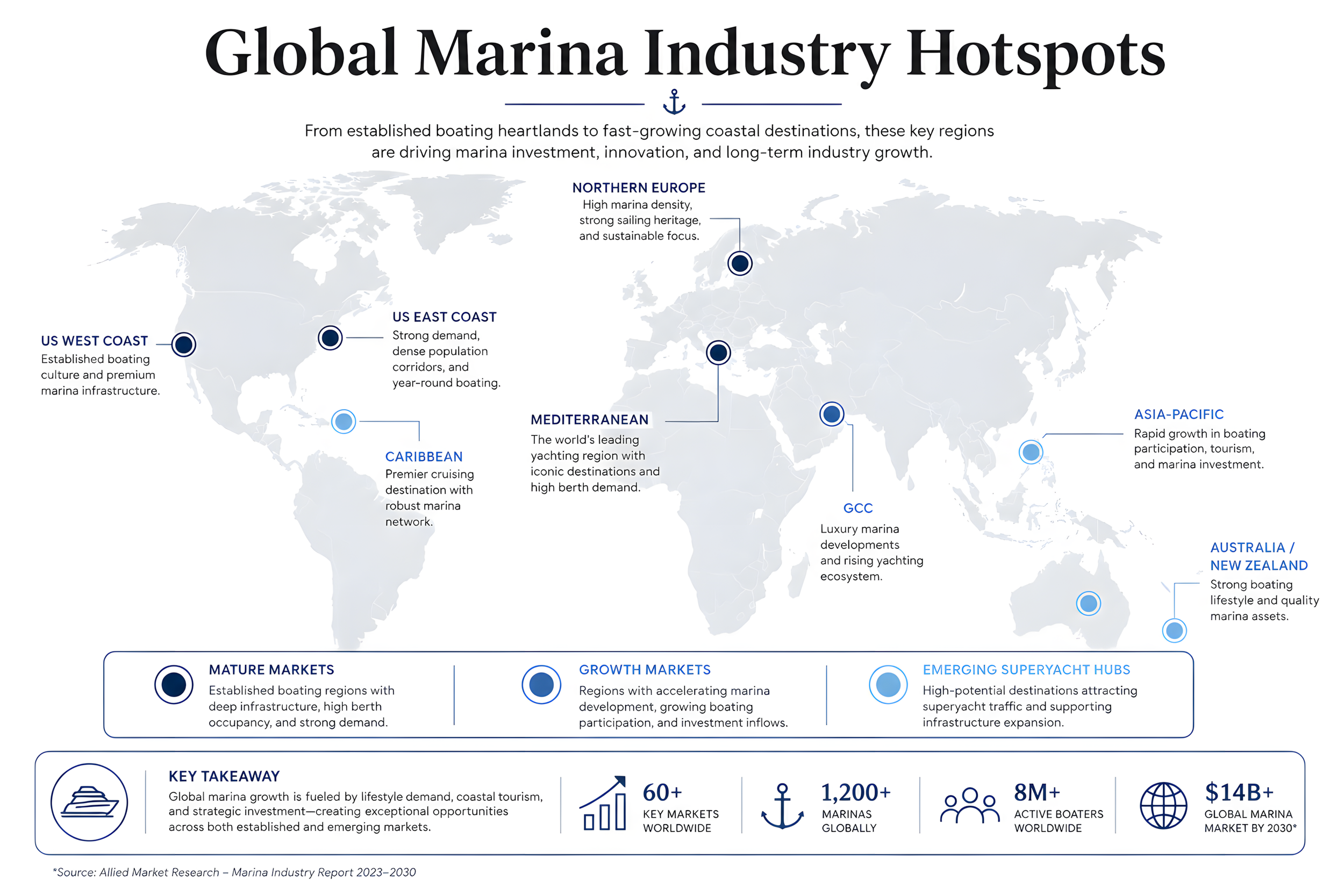
Few regions illustrate this new era better than the GCC, now one of the world's most dynamic waterfront markets. A wave of landmark developments — Dubai Islands, Palm Jebel Ali, Abu Dhabi's expansions, NEOM, Sindalah, AMAALA, The Red Sea, and Oman's tourism corridors — is reshaping the regional map. Sitting on the Europe–Asia superyacht corridor, the GCC increasingly attracts:
· transit traffic
· seasonal homeporting
· charter operations
· long-stay berthing demand
The result is a dual-market powerhouse: small boats drive volume, while large vessels drive value — and the most successful GCC marinas are being designed to serve both.
7. 2026: evolve, or fall behind
Tellingly, the biggest marina failures still happen before a single pontoon is installed — in the planning. The recurring mistakes are:
· the wrong berth mix
· underpowered utilities
· insufficient draft
· poor water circulation
· weak operational planning
· no environmental integration
· no AI readiness
The marinas that succeed in this new era will do the opposite: build for future vessel sizes, integrate AI from day one, prioritise environmental stability, deliver hospitality-level service, and align their infrastructure with operational reality. And for the many marinas already reaching the twenty-year mark, that evolution means a structured programme of assessment and reinstatement.
Frequently asked questions
-
Several pressures are peaking at once: fleet growth outpacing berth supply, larger vessels that older marinas can't serve, rising environmental and regulatory demands, and the arrival of AI in operations. Together they mark the shift from the old berth-supply model to a performance- and experience-led one.
-
Larger vessels typically need deeper water (often 5–7m draft), higher shore-power loads (commonly 600–1,000A), and larger turning basins (around 1.5–1.75× vessel length), along with high-capacity fuelling and crew facilities — requirements many pre-2010 marinas cannot meet.
-
It combines rapid new development with a strategic position on the Europe–Asia superyacht corridor, attracting transit traffic, seasonal homeporting, and charter demand — and it serves both a high-volume small-boat market and a high-value large-vessel market.
-
AI supports water-quality forecasting, berth-occupancy and energy-load prediction, safety and environmental anomaly detection, and compliance automation — increasingly a core part of how a marina is run, not an optional extra.
-
Planning errors made before construction — the wrong berth mix, underpowered utilities, insufficient draft, or poor circulation — which are expensive to fix later. Getting the strategy right at the design stage is the single highest-value decision.
The bottom line
The global marina industry is accelerating. Fleet growth, environmental pressure, customer expectations, and digital transformation are together remaking the future of waterfront development — and the GCC is at the centre of it. Homeport guides developers, owners, and governments through this new era with clarity, engineering depth, and global perspective.
Talk to Homeport about designing, upgrading, or repositioning your marina for the next decade.