
Assessment of Aging Marinas Across the GCC: Why 20-Year-Old Waterfronts Need Strategic Reinstatement
Many marinas built across the GCC in the early 2000s are now reaching twenty years old — the point where safety, infrastructure, and commercial performance begin to decline. Homeport assesses, reinstates, and repositions these aging waterfront assets to meet the region's high standards, using a structured process covering technical condition, safety gaps, operations, and commercial value. In the Gulf's warm, high-salinity conditions marinas age faster, which makes early, expert assessment critical to protecting the asset.
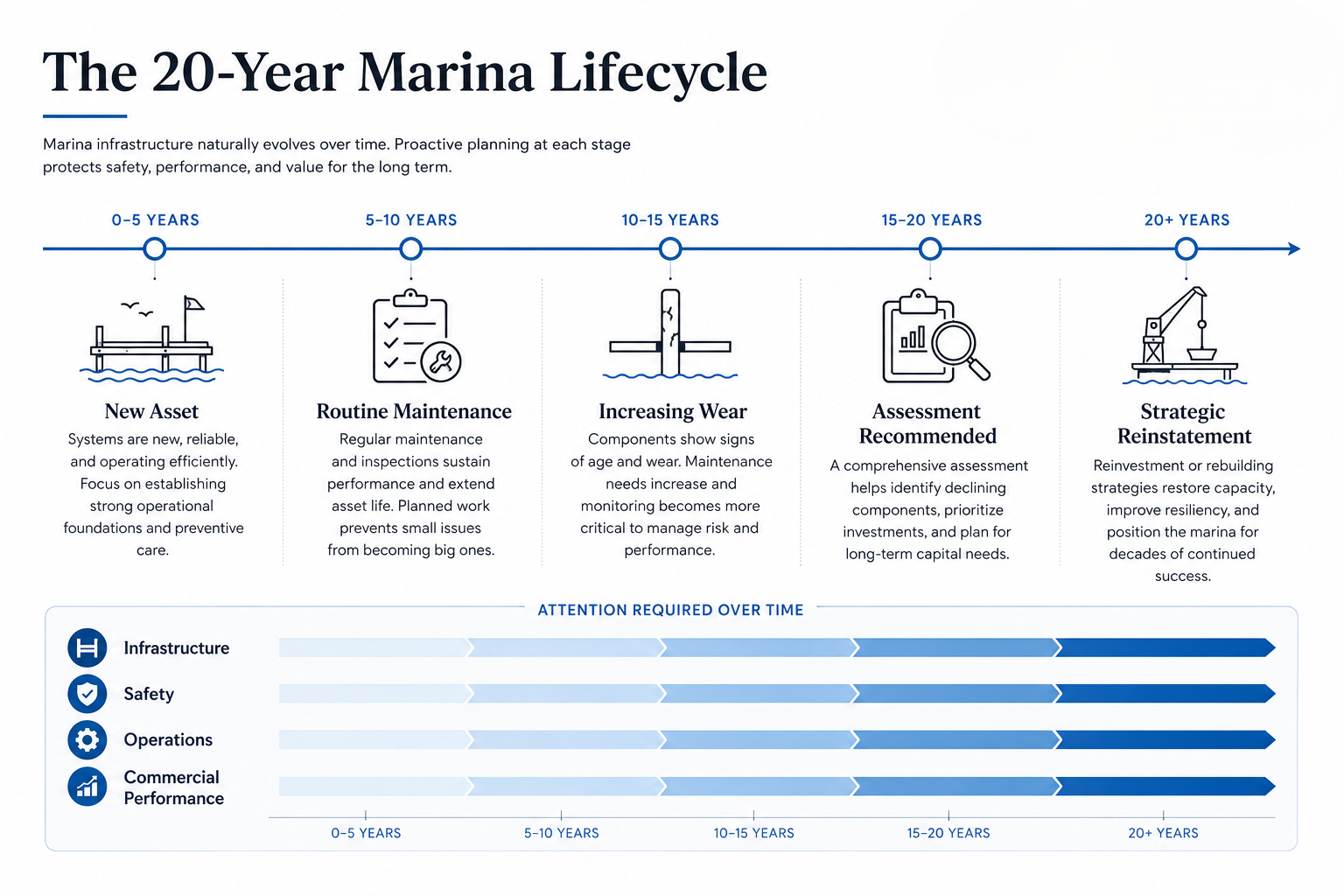
A marina is a long-life asset, but it is not a permanent one. Many of the marinas that opened across the UAE, Oman, Qatar, and Bahrain during the early 2000s are now reaching the twenty-year mark — the point at which infrastructure, safety systems, and commercial performance all begin to decline at once. In the GCC this moment arrives sooner and hits harder than in most markets: the water is warmer and saltier, the fleets are larger, and berth-holders expect a level of service set by the region's newest luxury developments. Homeport's assessments across the region show that aging Gulf marinas need a structured reinstatement strategy — not patchwork repairs — to stay safe, compliant, and competitive.
Why GCC marinas age faster
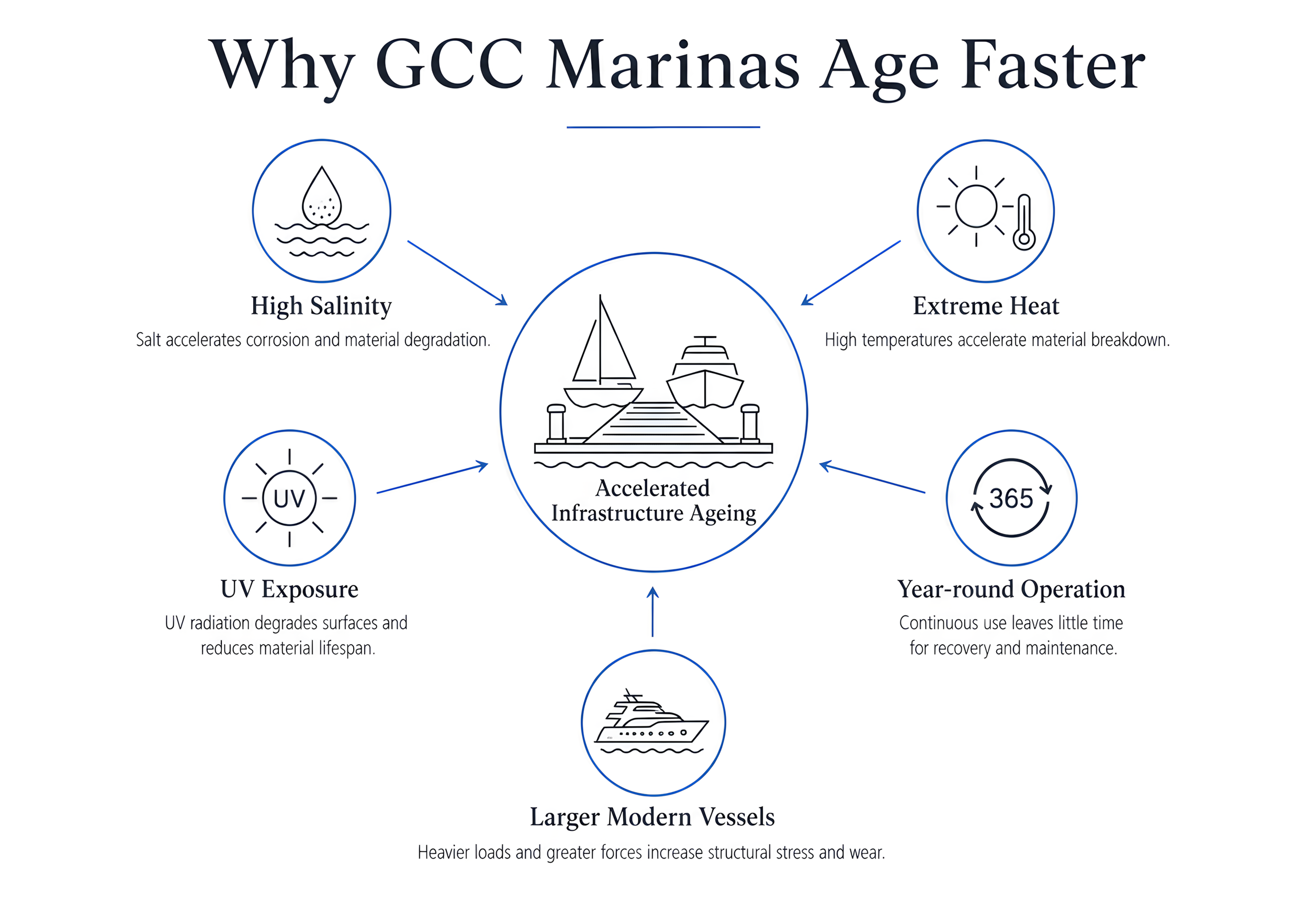
The Gulf is one of the most demanding marine environments on earth, and it places a unique combination of stresses on a marina:
· high salinity that accelerates corrosion of metals and fixings
· extreme heat and intense UV that degrade materials year-round
· continuous, year-round operation with little off-season for maintenance
· larger vessels and higher electrical loads than the marina was designed for
· premium hospitality expectations that outpace original facilities
Together, these conditions accelerate wear across every part of the marina — pontoons and fingers, utilities and electrical systems, breakwaters, mechanical plant, and the customer-facing facilities that shape the guest experience.
The safety gaps that emerge at twenty years
Safety is where aging shows up first, and where it matters most. Across its GCC assessments, Homeport frequently identifies a recurring set of issues in marinas of this age:
· electrical systems overloaded by larger, more power-hungry vessels
· fire suppression that no longer matches today's fleet and standards
· degraded pontoon and finger stability
· outdated emergency and rescue systems
· fuel-handling and bunkering safety gaps
· poor lighting and signage
· insufficient environmental monitoring
Closing these gaps is not optional. Safety reinstatement is essential both for regulatory compliance and for the marina's reputation — a single incident can undo years of brand-building.
Where operations quietly slip
Infrastructure is visible; operational decline is not — but berth-holders feel it every day. In aging marinas, Homeport commonly finds:
· inconsistent hospitality and service standards
· outdated standard operating procedures
· gaps in staff training
· unclear communication with berth-holders
· inconsistent cleanliness and presentation
· little or no digital booking, billing, or management
· weak environmental reporting
A marina's reputation rests on a simple promise: that it delivers the experience it advertises. Aging operations quietly break that promise — and in the GCC, where the benchmark is set by the region's newest flagship destinations, that gap is felt immediately.
The commercial opportunity in repositioning
Here is what makes marina reinstatement different from ordinary maintenance: done well, it is not a cost — it is a value-creation exercise. An aging marina sitting on a prime waterfront is often significantly under-earning against its location. A structured upgrade can unlock that value through:
· premium berth upgrades for larger, higher-value vessels
· hospitality and F&B integration
· an improved retail and amenity mix
· a genuinely luxury customer experience
· digital systems and AI-enabled management
· environmental technology, including water-quality systems
· dry-storage expansion to add capacity on land
· repositioning to higher-value market segments
· optimised, data-led pricing
The GCC's luxury market rewards marinas that modernise — and penalises those that stand still while newer destinations open next door.
Homeport's assessment and reinstatement approach
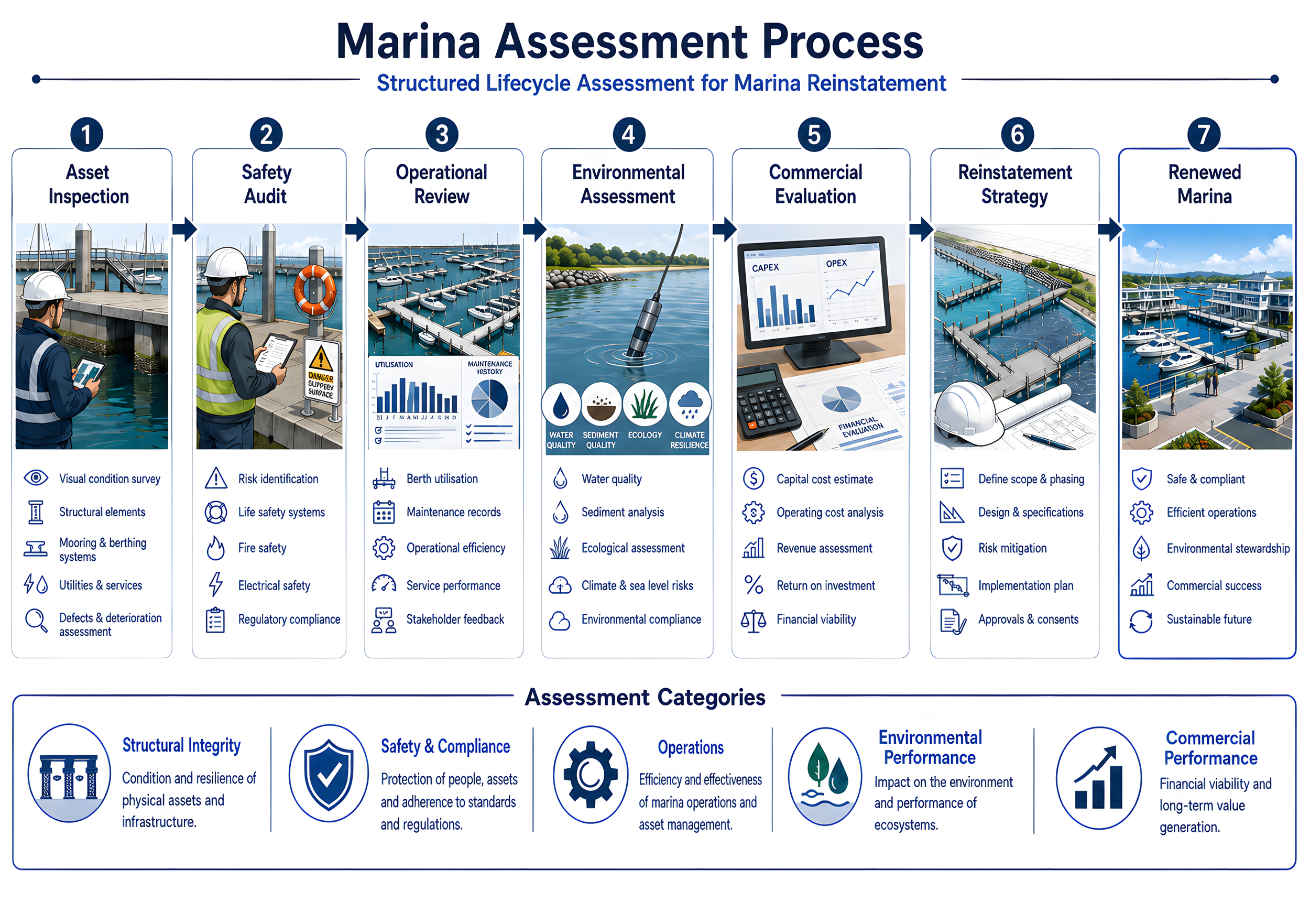
Homeport works to a structured, three-stage framework — assess, reinstate, reposition — that takes a tired asset and returns it to standard while lifting its long-term value. A full engagement typically includes:
· a full technical condition assessment
· a safety gap analysis
· a hydrology and wave-comfort review
· a utilities and infrastructure audit
· an environmental performance evaluation
· an operational systems review
· a commercial repositioning strategy
· a refurbishment scope with phasing
· CAPEX planning
· a long-term asset-management model
The result is a clear, phased plan that recovers a marina's safety, performance, and commercial value — with the disruption and spend sequenced so the asset keeps trading while it is upgraded.
What this means, market by market
The reinstatement priority differs across the region:
· UAE — luxury fleets demand premium service and fully modern infrastructure
· Saudi Arabia — as new giga-projects open, established marinas must reposition to keep pace
· Oman — environmental performance and safety are becoming key differentiators
· Qatar & Bahrain — high-value fleets expect a modernised, service-led customer experience
Frequently asked questions
-
Most marinas reach a critical point around twenty years, when infrastructure, safety systems, and operations begin to decline together. In the GCC's warm, high-salinity conditions this can arrive sooner, so a professional assessment from around the fifteen-year mark is wise.
-
No. Maintenance keeps a marina running; reinstatement returns it to standard and repositions it for higher value — combining safety and infrastructure upgrades with operational and commercial improvements.
-
High salinity, extreme heat, intense UV, and year-round operation place exceptional stress on materials and systems, accelerating wear on pontoons, utilities, and mechanical plant.
-
In most cases, yes. Homeport phases the scope so the marina keeps trading while work proceeds, sequencing disruption and spend to protect revenue.
-
A full technical, safety, environmental, operational, and commercial review — delivered as a phased reinstatement and repositioning plan with a CAPEX budget and a long-term asset-management model.
The bottom line
Aging marinas across the GCC face accelerated wear, rising expectations, and mounting competition from newer destinations — but they also hold major untapped commercial value. Assessed, reinstated, and repositioned properly, a twenty-year-old marina can once again become one of the strongest-performing assets on its waterfront.